by Brett | Jul 13, 2026
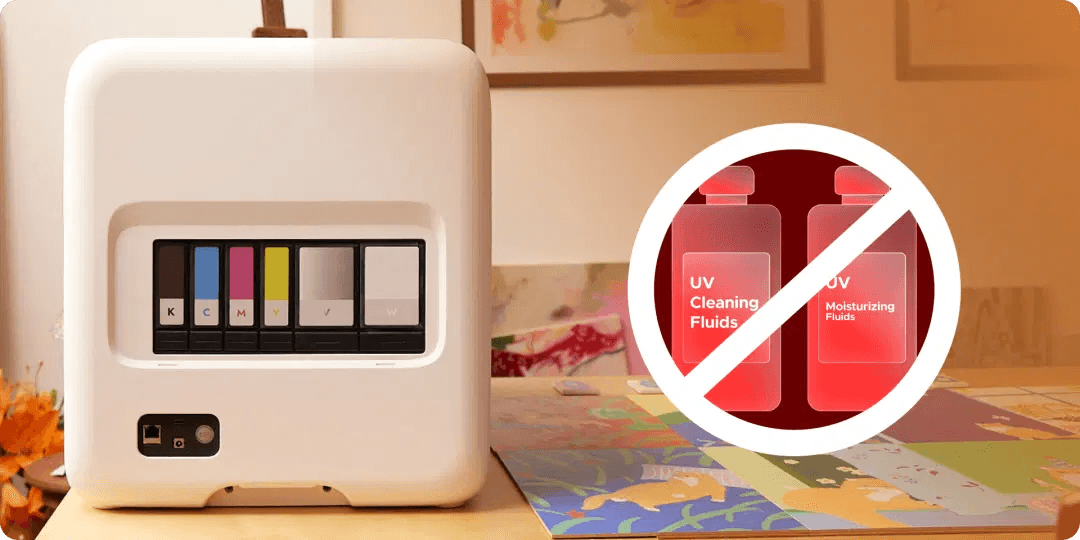
A lot of people have asked me one question: why doesn’t Morpho have separate cleaning liquid or moisturizing liquid?
It sounds like a small consumables question, but behind it is a very different way of thinking about maintenance for desktop UV printers.
If you look at some desktop UV printers on the market today, their consumables are not just UV ink. Many of them also use cleaning liquid and moisturizing liquid. Some machines separate the two. Some combine them into one liquid. The names may be different, but the logic is similar: the machine does not want UV ink to stay inside the printhead and ink path for too long, so it needs another liquid to replace it.
Why does it have to be this complicated?
It starts with the printhead.
Many desktop UV printers use Epson F1080-class printheads, often called XP600-class heads, mainly because of cost. These printheads are relatively inexpensive, and they were originally designed for water-based ink systems.
Water-based ink and UV ink are very different. UV ink contains chemical components that can be more challenging for certain materials inside the printhead and ink path. For example, inside the printhead there may be adhesives, seals, or other internal structural materials. If UV ink stays inside a printhead that was not designed for it, even when the machine is not printing, some of these materials may slowly swell or age. Once that happens, the very precise internal structure of the printhead can be affected, and the printhead may eventually fail.
That is why many machines use a fairly complicated maintenance process.
When the machine is not being used, it first pulls the UV ink out of the printhead and ink path. But even after that, there is still residue inside the tubes and printhead, so the system needs cleaning liquid to flush it out. The job of the cleaning liquid is to remove as much leftover UV ink as possible.
But cleaning liquid has its own issue.
The reason it can clean UV ink is that its chemistry is somewhat similar to UV ink. There is a simple idea in chemistry: like dissolves like. So cleaning liquid is usually not a completely gentle liquid either. It may also affect some materials inside the printhead. Because of that, cleaning liquid cannot stay inside the printhead for a long time.
So the machine then needs to drain the cleaning liquid and fill the printhead with moisturizing liquid. The moisturizing liquid stays inside the printhead during storage. When you want to print again, the whole process has to run in reverse: drain the moisturizing liquid, then bring UV ink back into the ink path and printhead.
There is a lot of waste in this process. Every time you leave the machine unused for a while, it has to pull the UV ink out, clean the system, and replace it with moisturizing liquid. When you want to use the machine again, it does the reverse and brings the UV ink back. Each cycle takes away some ink and consumes cleaning liquid and moisturizing liquid. If this happens again and again, the waste becomes very noticeable.
When we first looked at this problem at Morpho, we did not want to start by adding an even more complicated liquid system.
We first asked a very basic question: why does UV ink corrode the printhead?
UV ink is not a single material. It contains many functional components, such as photoinitiators, stabilizers, monomers, resins, and other additives. For each functional component, there are many different chemical materials to choose from.
So we did a lot of testing. We looked at how different functional components affected the printhead materials and ink path materials. We studied which materials were more likely to cause swelling, and which materials were more friendly to the key materials inside Epson printheads. Then we used those lower-corrosion materials to design our own UV ink formulation.
That is where Morpho EcoInk comes from.
We did not simply take an off-the-shelf UV ink and put it into the machine. From day one, Morpho was not designed like a traditional factory machine. We wanted it to work in small studios, creator spaces, and even home workrooms. So the ink cannot be judged only by print performance. Odor, VOC emissions, corrosion, and long-term stability all have to be considered together.
Morpho EcoInk has also received GREENGUARD Gold Certification. The certificate shows that Morpho Ink Jet Ink I10 Series meets the requirements for GREENGUARD Gold and UL 2818 - 2022 Gold Standard for Chemical Emissions. This certification focuses on low chemical emissions.
We also have a TÜV test report showing that 80% of participants rated the odor acceptability of Morpho ink higher than E-brand ink. This is a user-perception test, so I would not treat it the same way as a chemical emissions certification, but it does match what many people notice when they experience the ink in person.
Of course, ink is only one part of the system.
Morpho’s ink system also has automatic maintenance built in. This includes automatic white ink stirring and circulation, scheduled nozzle flashing, printhead temperature management, and other maintenance routines performed by the system. As long as the machine stays powered on, the system takes care of the ink path and keeps the white ink active, reducing the risk of settling and clogging.
So during routine idle periods and storage, Morpho does not require users to drain UV ink, flush the system with cleaning liquid, and then fill the printhead with moisturizing liquid.
This difference brings some very direct benefits.
First, it saves ink.
Traditional maintenance routines take away some ink every time they replace one liquid with another. This becomes especially noticeable if you are not printing large volumes every day. By reducing this kind of liquid replacement, Morpho also reduces waste ink.
Second, it saves consumables.
Cleaning liquid and moisturizing liquid are consumables too. They are not something you buy once and forget about. As long as the machine is used over time, they continue to be consumed. Since Morpho does not use this kind of routine storage liquid replacement process, that part of the cost is also reduced.
Third, it makes the machine easier to live with.
With fewer valves, fewer tube-switching steps, and fewer liquid replacement actions, the system becomes simpler. For a desktop product, this matters. Desktop users do not necessarily have the time or patience to maintain a machine like an industrial printer every day.
Physics First is an important part of Morpho’s company culture, and it is one of our basic beliefs when building products. In this case, it also includes chemistry first. When we face a problem, we first look at the root cause. Why does the printhead fail? Why does the ink corrode materials? Why does white ink settle? Why do certain materials swell? Once we understand these questions, we can design the ink, the ink path, and the maintenance strategy around the real cause.
We also ask our engineers to think about failure modes before finalizing a design. Where might this design fail? Under what conditions might it fail? If it fails, will it affect the user? It is much better to think through these questions during the design stage than to finish the design, open the molds, find problems later, and then patch things again and again.
This is why we spent so much time developing our own ink, and why Morpho does not have separate cleaning liquid or moisturizing liquid.
For creators, the machine should be ready when you want to use it. When you want to print, you should be able to print — not first think about whether you need to drain ink, flush the system, add moisturizing liquid, and then bring the ink back again.
